The AI-Prepared Client: Rethinking AI's Role in the Advisor / Client Relationship
AI may change more than advisor productivity. It may change what clients expect from their advisors.
Trevor Hicks
Founder, Stack Strategy
I've increasingly heard about clients arriving to advisor meetings with something new: financial research and recommendations generated by AI.
These conversations seem to follow a familiar pattern: clients show up with AI-generated financial advice, and advisors find themselves playing defense.
From the client's perspective, they took time to research and prepare for their meeting.
From the the advisor's perspective, the instinct may be to defend their value by pointing out what the AI response missed -- or to wonder whether the client is beginning to question the need for human based professional advice.
From my perspective, the more I've thought about this, the less convinced I am that it represents a threat to the advisor.
Clients rarely arrive at a meeting -- AI notes or not -- because they intend to end the relationship. More often, they're trying to get greater value from the relationship they have with their advisor.
Observation: The client / advisor relationship is changing, not disappearing
In my first LinkedIn article, Learning to work with AI, I wrote:
AI does not replace human judgment. It raises the bar for it.
AI can help clients gather information and ask better questions. But turning that information into meaningful advice requires context: goals, tradeoffs, family circumstances, risk, taxes and years of accumulated conversations.
This perspective connects to one of the biggest lessons I took away from an AI-driven leadership course I took at Stanford: AI is only as effective as the context surrounding it.
In one case study involving COVID diagnostic models, AI systems learned to rely on irrelevant signals in medical images because the technical teams lacked the clinical context to recognize what the models were actually detecting.
In other words, the model was functioning, but the teams lacked the context to recognize that it had learned the wrong signals; therefore, the result was flawed.
The same principle applies in wealth management.
AI doesn't know the client's complete tax picture, estate plan, family dynamics, tolerance for risk or long-term goals... and it doesn't have the benefit of years of conversations or recognize when something that appears financially optimal may not fit the life the client is trying to build.
AI can provide information and perspective, but its usefulness depends heavily on the context it has to work with.
That is what makes this opportunity so interesting to me. Instead of treating AI as something that competes with the advisor relationship, firms can help clients use it in ways that deepen trust and improve the conversations already taking place.
Advice: Add AI to the meeting-preparation workflow
Imagine an advisor giving their client a recommended AI prompt before their next meeting.
The goal would not be to encourage the client to seek financial recommendations outside the relationship, but to help the client organize their thoughts, identify useful questions and arrive better prepared for the conversation with their financial advisor.
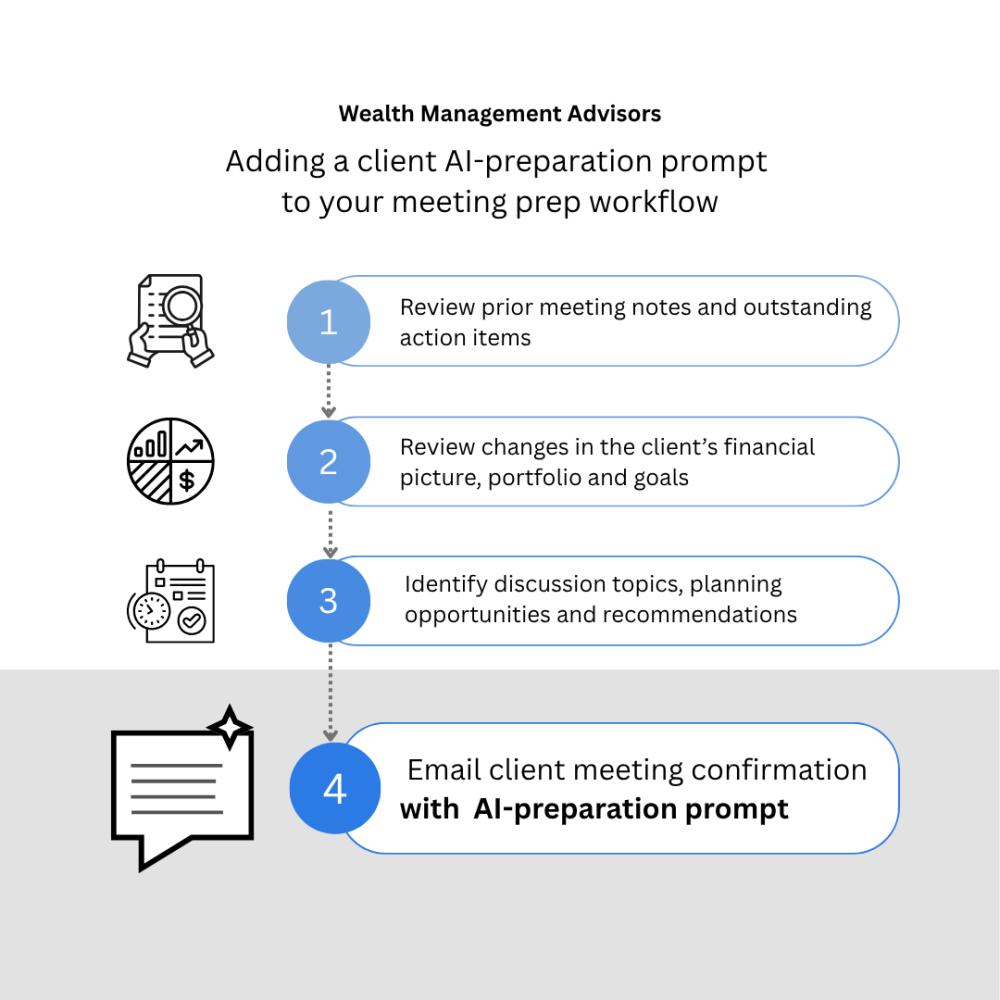
Today, an advisor's meeting-preparation workflow might look something like this:
- Review prior meeting notes, CRM activity, and outstanding action items
- Review changes in the client's financial picture, portfolio, and goals
- Identify discussion topics, planning opportunities, and recommendations to build a meeting agenda
For many firms, the client-facing preparation ends with a meeting confirmation and a request for any updated information.
I see an opportunity to add another step:
- Send the client a tailored AI-preparation prompt before the meeting
The advisor already has an idea of the agenda and likely discussion topics.
The client may already be using AI to prepare themselves for this meeting independently.
Instead of leaving the client to navigate that process alone, the advisor can help frame how the AI tool is used. With the right guidance, AI can help the client organize their thoughts, surface questions they may not have considered and arrive better prepared for the conversation.
Example: What an AI-prepared client prompt could look like
Today, advisors send pre-meeting emails to confirm date / time and ask whether anything has changed since the last conversation.
In the future, I imagine one more element added to these emails: a prompt the client can use to prepare with AI before the meeting. One that does not discourage AI use or try to protect the advisor from being replaced. Rather, a prompt framing AI as a preparation tool, ultimately creating a better starting point for the meeting.
This is intentionally a broad starting point. An advisor could use a version like this across many client relationships today.
Over time, I expect these prompts to become more tailored to the client, the purpose of the meeting and the context already available within the firm's technology environment.
AI can strengthen the conversation
Clients are already bringing AI into the advisor relationship. But that doesn't change the importance of the advisor.
It raises expectations for how advisors help clients interpret information, provide context and make decisions.
Advisors who teach clients how to use AI as a thought partner can help them arrive more informed, more organized and better prepared. In that sense, AI becomes more than an internal productivity tool.
It becomes part of the client experience.
I'll leave you with this: The firms that benefit most may not be the ones trying to slow client adoption. They may be the ones helping shape it, giving clients a better way to prepare while reinforcing where informed, contextual advice still belongs.
Originally published on LinkedIn by Trevor Hicks.