How Early Technology Decisions Influence the Future Operating Model
As firms grow, early technology decisions can quietly shape the operating model that follows.
Trevor Hicks
Founder, Stack Strategy
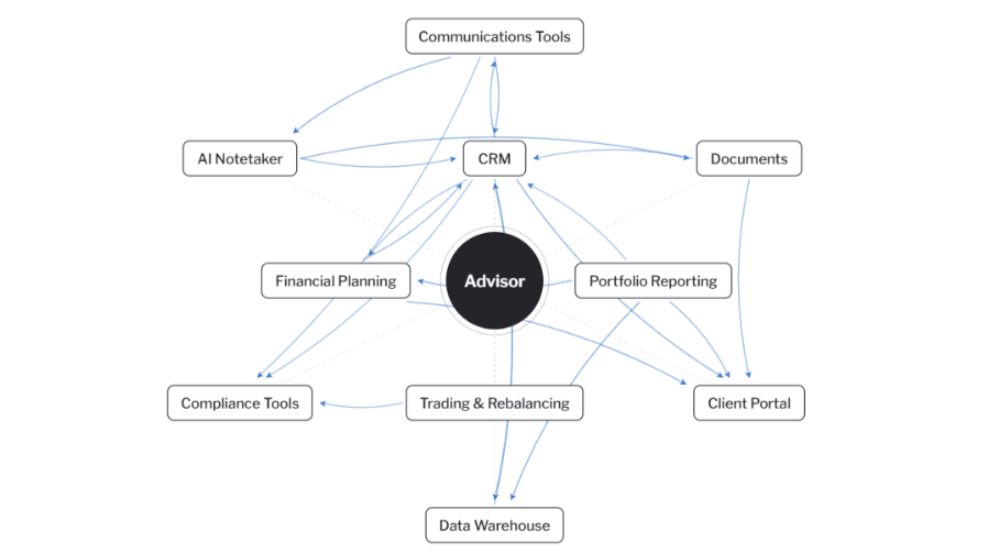
Throughout my career in wealth management, I've seen how technology environments gradually become more complex as firms grow.
My belief was that finding best-in-class solutions was a priority over simplifying the environment. If there was a platform that solved a problem exceptionally well, I wanted to evaluate it thoroughly.
And to be fair, this approach can absolutely work.
I had a strong technology team, operational support, formal evaluation processes, and the internal capacity to manage a complex environment.
But what I learned over time is that complexity compounds quietly.
New firm = manageable technology environment
Early in a firm's lifecycle, technology environments are usually manageable. One person, or a small team, can operate effectively across a handful of systems, even if some processes are manual or loosely connected.
Growth changes the equation
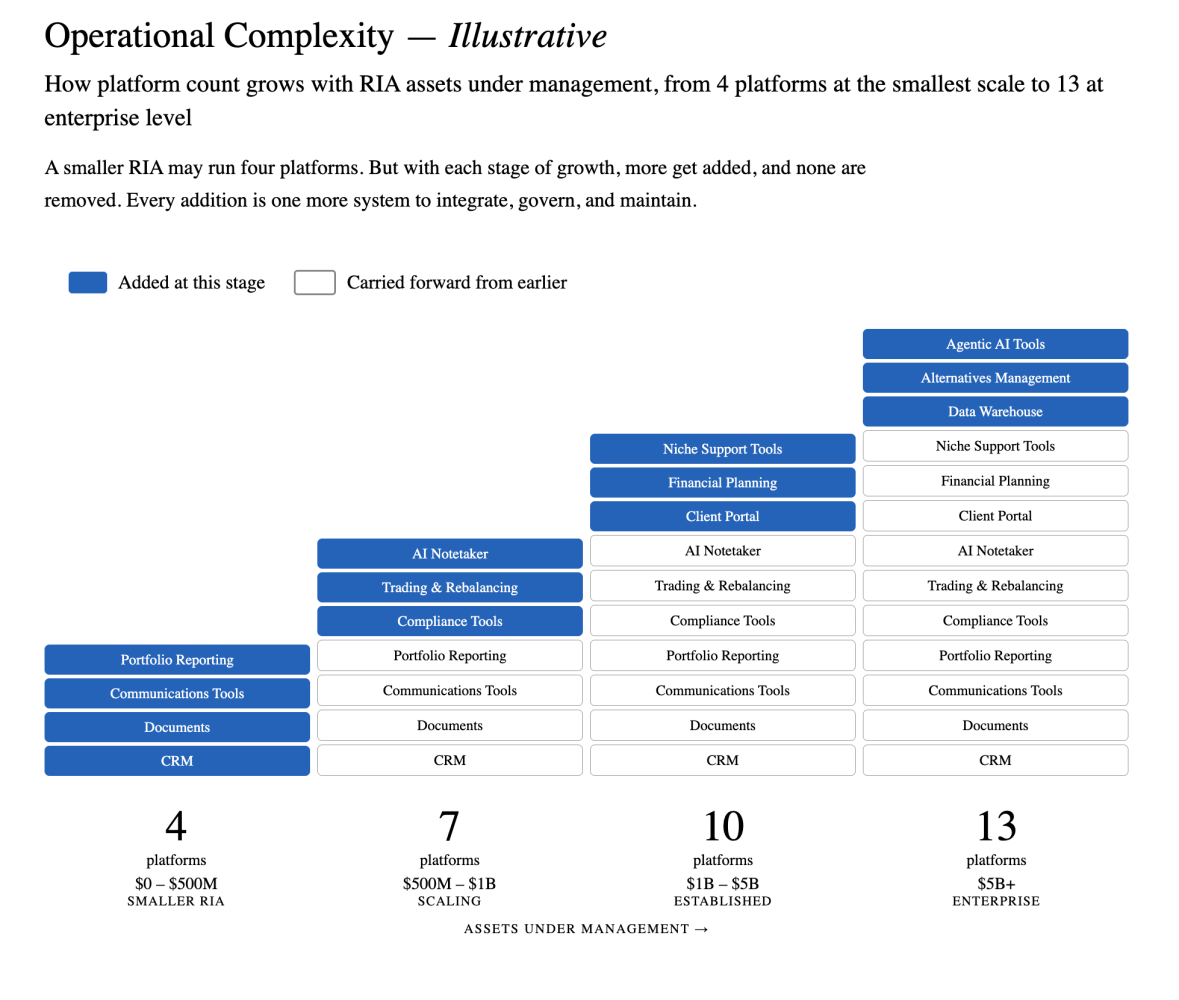
Operational Complexity Over Time
More advisors + More employees + More custodians + More workflows + More client expectations
= New point solutions added to solve immediate business needs.
The challenge: Every new point solution introduces another layer of integration, training, governance, support, vendor management, risk, and operational dependency.
Over time, this creates operational friction.
- Systems don't fully communicate
- Data lives in multiple places
- Workflows become fragmented across platforms
- Employees navigate multiple interfaces and processes
And perhaps, the most difficult friction to overcome: A growing reliance on institutional knowledge to keep complex environments operationally aligned.
Eventually, technology management becomes a significant operational function
Once the systems that workflows and processes rely on become disconnected – variations in data context, lack of consistency in workflows – technology management itself becomes a significant operational function inside the firm.
This becomes even more relevant as firms begin exploring AI initiatives.
AI tends to expose the maturity – or fragmentation – of a firm's underlying environment very quickly.
The cycle continues: firms add additional layers to make the environment usable for broader automation.
The conversation that signals "complexity has compounded"
One signal that complexity has compounded is when the conversation shifts from technology tools to operating model design.
- Data warehouse and data lakes
- Integration architecture
- Governance structures
- Specialized support staff
And to state the obvious, this is not intentional. I have yet to come across a firm that intentionally created unnecessary complexity. It's simply the result of growth, evolving business needs, and reasonable decisions made over time.
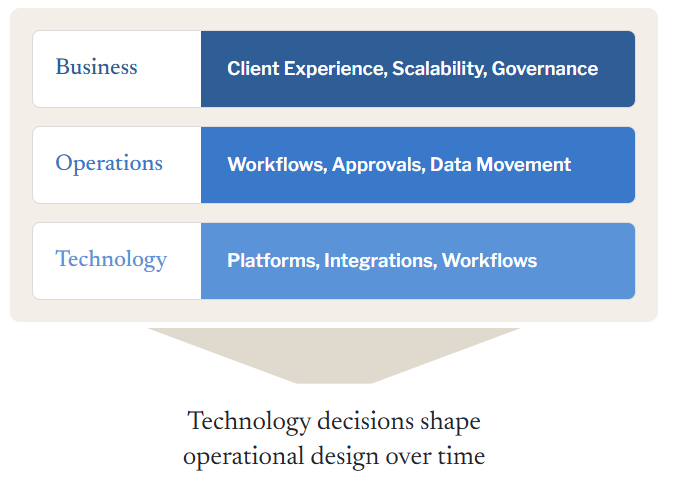
Similar to the people, process, and technology alignment discussed previously, technology decisions eventually become deeply embedded in how firms operate.
How to avoid this complexity
I believe firms should think strategically about platform decisions earlier than they think they need to.
You're building a foundation for future growth. The goal is not perfection from day one. It's creating an environment flexible enough to evolve with the needs of the business over time.
Because technology decisions made during periods of growth tend to persist far longer than expected.
And once operational processes, integrations, and institutional knowledge become deeply tied to a fragmented environment, simplifying later becomes much harder.
Find what gives your firm the most operational runway
Sometimes the best technology decision is not the platform with the longest feature checklist.
Sometimes it's the platform that gives the firm the most operational runway over time.
When firms get this right, technology stops being just a support function.
It becomes part of how the firm itself operates.
Originally published on LinkedIn by Trevor Hicks.